
Plow vs. No-Till: Is “Strategic Tillage” the Only Path to Profit?
Piše: CEO FarmBooker-a
In modern agriculture, the question is no longer if we should change how we till the soil—it has become a matter of survival. For decades, we have lived between two extremes: the European conservatism of deep plowing and the American-Latino model of No-Till (direct seeding).
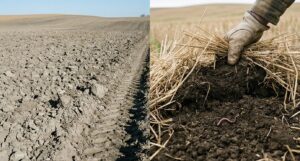
Today, in 2026, both systems are evolving. While many are rapidly abandoning the plow in favor of reduced tillage, pioneers of direct seeding in Argentina and the US are reintroducing occasional, strategic intervention. Where do these two philosophies meet, and what is truly best for your soil?
1. The Myth of the Plow: Why the “Black Furrow” Destroys Your Capital
For a long time, plowing was considered the only way to “clean” and “rest” the land. In reality, the plow is an aggressive tool with consequences that are often irreversible:
-
Permanent Structure Destruction: The FAO (Food and Agriculture Organization) warns that plowing brutally severs the fungal networks (mycorrhizae) and earthworm burrows essential for natural drainage and nutrient uptake.
-
Humus Oxidation: Flipping the
-
soil exposes organic matter to direct sunlight and oxygen. The result? Your humus literally “burns up,” depleting fertility year after year.
-
Plow Pan: At 25–30 cm, a compacted layer—an “invisible concrete wall”—forms. It prevents roots from going deep and stops water from infiltrating, suffocating crops during heavy rains.
2. No-Till Lessons: Realities from Argentina and the US
Argentina, Brazil, and the US are the birthplaces of direct seeding. They spent decades planting without tillage, successfully conserving moisture.
However, after 20+ years of zero-tillage, these systems hit a wall:
-
Evolution of “Super-Weeds”: Over-reliance on herbicides without mechanical weed control has created resistant species (like Amaranthus palmeri) that chemicals can no longer stop.
-
Nutrient Stratification: Phosphorus and potassium, applied on the surface, stay in the top 5 cm of soil. Without moisture at the surface, the roots below go “hungry” while the fertilizer sits out of reach.
-
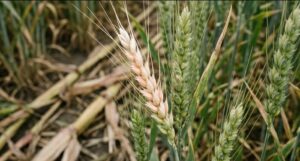
Pathogen Pressure: Crop residues act as a perfect “incubator” for fungi like Fusarium and pests like slugs.

3. Strategic Tillage and Cover Crops: The Smart Compromise
The solution is not a return to the past, but Strategic Tillage. This is a system where steel is used only when nature cannot finish the job alone.
When is a plow or a ripper your ally?
-
System “Reset”: Once every 4 to 5 years, controlled tillage is necessary to destroy resistant weeds and redistribute nutrients throughout the soil profile.
-
Organic Matter Incorporation: For the proper treatment of solid manure, light plowing remains the most effective method to ensure decomposition without losing nitroge
-
n to the atmosphere.
-
Cover Crops – The Biological Plow: Instead of loosening soil only with steel, use plants.
-
On heavy soils, choose cover crops with powerful taproots (like tillage radish) to perform “biological subsoiling.”
-
On light soils, use legumes for nitrogen fixation. Choosing the right cover crops replaces the need for deep mechanical tillage.
-
What Is Best for Your Profit?
Agriculture today is resource management. The plow is a tool of the past for daily use, but a useful tool for a periodic “reset.”
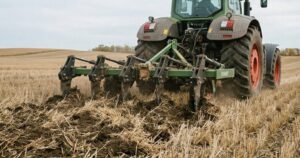
My Recommendation: Focus on reduced tillage. Protect your soil biology, choose cover crops tailored to your soil type, and use heavy machinery strategically—only where data proves compaction exists. Combining soil structure preservation with precision technology is the only path to stable yields in the years to come.